In the circuit shown in figure reading of voltmeter is $V_{1}$ when only $S_{1}$ is closed, reading of voltmeter is $V_{2}$ when only $S_{2}$ is closed and reading of voltmeter is $V_{3}$ when both $S_{1}$ and $S_{2}$ are closed. Then 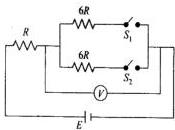
A$V_{3} > V_{2} > V_{1}$
B$V_{2} > V_{1} > V_{3}$
C$V_{3} > V_{1} > V_{2}$
D$V_{1} > V_{2} > V_{3}$
Answer & Solution
Correct answer: B. $V_{2} > V_{1} > V_{3}$
The voltmeter is connected across the inner network, so it reads the potential difference across that branch.
When only $S_{1}$ is closed, the circuit has $R$ in series with $6R$.
$$V_{1}=E\frac{6R}{R+6R}=\frac{6E}{7}$$
When only $S_{2}$ is closed, the situation is identical because again only one $6R$ branch is active.
$$V_{2}=E\frac{6R}{R+6R}=\frac{6E}{7}$$
When both $S_{1}$ and $S_{2}$ are closed, the two $6R$ resistors are in parallel.
$$R_{\text{eq}}=\frac{6R\cdot 6R}{6R+6R}=3R$$
Now the circuit has $R$ in series with $3R$, so the voltmeter reads across $3R$.
$$V_{3}=E\frac{3R}{R+3R}=\frac{3E}{4}$$
Compare the values:
$$\frac{3E}{4}<\frac{6E}{7}$$
So $V_{1}=V_{2}>V_{3}$. Among the given choices, the matching ordering is $V_{2}>V_{1}>V_{3}$, since $V_{1}$ and $V_{2}$ are equal and both exceed $V_{3}$.
Related questions
The reactance of a capacitor $C$ at frequency $f$ in an a.c. circuit is:A bird perched on a single high voltage wire is unharmed because:The two conservation laws embodied in Kirchhoff's rules are conservation of:The resistance offered by the cell itself is called:Which device detects the current in a Wheatstone bridge?In a Wheatstone bridge, the source is connected across the:The Wheatstone bridge is made up of how many resistors?At a junction, the current entering equals the current: