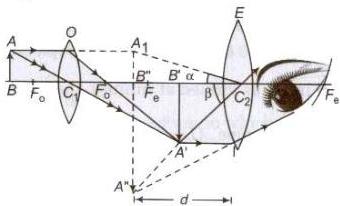
 The figure shows a compound microscope. For its magnifying power to be large, the focal lengths $f_o$ (objective) and $f_e$ (eyepiece) should satisfy:
A$f_o < f_e$, both small
B$f_o > f_e$, both large
C$f_o \gg f_e$
DFocal lengths do not affect magnification; only the apertures matter
Answer & Solution
Correct answer: A. $f_o < f_e$, both small
**Magnifying power of a compound microscope** (image at infinity): $M = \dfrac{L \cdot D}{f_o \cdot f_e}$, where $L$ is the tube length and $D$ is the least distance of distinct vision.
**Read off the requirement.** Both $f_o$ and $f_e$ sit in the *denominator*, so both should be **small** to maximise $M$. Convention places the objective slightly smaller than the eyepiece: $f_o < f_e$.
**Why option C (much smaller) is wrong** — strictly, $f_o < f_e$ but not by orders of magnitude; *both* must remain small to keep $M$ high. A very small $f_o$ with a long $f_e$ would shrink the product less than two reasonably small focal lengths.
**Compare with the telescope** (next figure): there, $f_o \gg f_e$ because $M_{\text{tel}} = f_o / f_e$ — focal lengths play the opposite role.
Related questions
Two thin convex lenses, each of focal length 20 cm, are placed coaxially 10 cm apart in aiA Galilean telescope (objective convex, eyepiece concave) has objective focal length 20 cmA thin prism of refracting angle 5° is made of glass with n = 1.5. The deviation δ of a liRefraction at a single convex spherical surface: an object in air (n₁ = 1) at distance 20 A converging lens of focal length f is split along its principal axis into two semicirculaA compound microscope has an objective of focal length 1.0 cm and an eyepiece of focal lenGlass has refractive index 1.5 with respect to air. A light ray inside the glass strikes tThe apparent depth of an object lying at the bottom of a pool of water (n = 4/3) is, in te