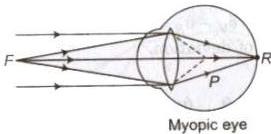
 The figure shows an eye defect in which parallel light rays from a distant object converge at a point in front of the retina. This defect, and the lens used to correct it, are:
AHypermetropia (long-sightedness), corrected by a convex lens
BMyopia (short-sightedness), corrected by a concave lens
CAstigmatism, corrected by a cylindrical lens
DPresbyopia, corrected by a bifocal lens
Answer & Solution
Correct answer: B. Myopia (short-sightedness), corrected by a concave lens
**Identify the defect.** Distant rays converging *in front of* the retina means the eye is over-converging — the eyeball is too long (or the lens too powerful). This is **myopia** (short-sightedness): the person sees nearby objects clearly but distant objects appear blurred.
**Correction.** A **concave (diverging) lens** in front of the eye spreads the incoming rays out before they hit the eye lens, so the effective focal point shifts back onto the retina.
**Why the distractors are tempting.**
- Hypermetropia is the *opposite* — image forms *behind* the retina, corrected by a convex lens (option A).
- Astigmatism is irregular curvature, corrected by a *cylindrical* lens (option C).
- Presbyopia is age-related loss of accommodation, corrected by bifocals (option D).
Related questions
Two thin convex lenses, each of focal length 20 cm, are placed coaxially 10 cm apart in aiA Galilean telescope (objective convex, eyepiece concave) has objective focal length 20 cmA thin prism of refracting angle 5° is made of glass with n = 1.5. The deviation δ of a liRefraction at a single convex spherical surface: an object in air (n₁ = 1) at distance 20 A converging lens of focal length f is split along its principal axis into two semicirculaA compound microscope has an objective of focal length 1.0 cm and an eyepiece of focal lenGlass has refractive index 1.5 with respect to air. A light ray inside the glass strikes tThe apparent depth of an object lying at the bottom of a pool of water (n = 4/3) is, in te