In the **parallelogram law** of vector addition, if $\vec a$ and $\vec b$ act along two adjacent sides $\overrightarrow{AB}$ and $\overrightarrow{AD}$ of a parallelogram, then $\vec a + \vec b$ is represented by: 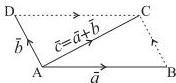
AThe opposite side $\overrightarrow{DC}$
BThe diagonal $\overrightarrow{AC}$
CThe diagonal $\overrightarrow{BD}$
DThe side $\overrightarrow{CB}$
Answer & Solution
Correct answer: B. The diagonal $\overrightarrow{AC}$
Parallelogram law: with $\overrightarrow{AB} = \vec a$ and $\overrightarrow{AD} = \vec b$, the resultant $\vec a + \vec b$ is the diagonal $\overrightarrow{AC}$ emanating from the common initial point A. (The other diagonal $\overrightarrow{BD}$ represents $\vec b - \vec a$.)
Related questions
Vector $PQ$ has magnitude 5 units and is inclined at $150^{\circ}$ to the $x$-axis. In theForces $2i-5j+6k$ and $-i-2j-k$ move a particle from $A(4,-3,-2)$ to $B(6,-1,-3)$. The worPosition vectors $2i-j+k$, $i-3j-5k$ and $3i-4j-4k$ form a triangle with sides $ qrt{41}$,When are two vectors counted as equal?What is the magnitude of the position vector with components 9 and 12?Which two features identify a vector?The work done by a constant force F in displacement d isIf a, b, c are mutually perpendicular unit vectors, the value of a · (b × c) is