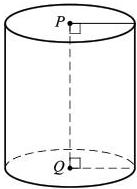
 The right circular cylinder above (Geometry Figure 30) has axis $PQ$. If the radius of each circular base is $r = 4$ and the length of axis $PQ$ is $7$, what is the **volume** of the cylinder?
A$112 \pi$
B$56 \pi$
C$28 \pi$
D$196 \pi$
Answer & Solution
Correct answer: A. $112 \pi$
For a right circular cylinder, the axis is perpendicular to the bases, so the length of the axis equals the height. Here $h = 7$.
Volume: $V = \pi r^{2} h = \pi (4^{2})(7) = \pi (16)(7) = 112 \pi$.
- Trap A ($28 \pi = \pi \cdot 4 \cdot 7$) uses $r$ rather than $r^{2}$.
- Trap B ($56 \pi = 2 \pi r h$) gives the lateral surface area, not the volume.
- Trap D ($196 \pi = 49 \pi \cdot 4$) confuses $r$ and $h$ in the squaring.
The figure is essential because it labels the axis $PQ$ as the cylinder's principal axis — without that label you might not realise the labelled segment is the height.
Related questions
GMAT DS questions should be paced at:The sum of 5 consecutive integers is always divisible by:If x² = 36, what can we conclude about x?A GMAT PS question asks: 'What is x if 3x + 5 = 23?' Options: 4, 5, 6, 7. The fastest apprOn a percentage question with abstract values, the recommended smart-number to assume is:Is 1,287 divisible by 3?In a GMAT DS question, what is the FIRST step?In GMAT DS, answer choice (A) is selected when: