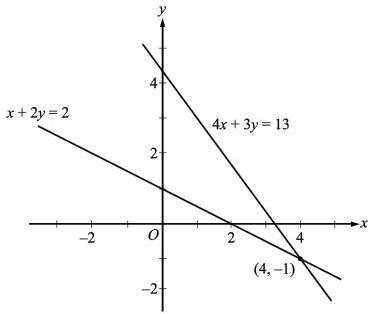
 The graph above shows the two linear equations $\quad 4x + 3y = 13$ $\quad x + 2y = 2$ graphed in the $xy$-plane. From the graph, what is the **solution** of the system (i.e. the $(x, y)$ pair satisfying both equations)?
A$(-1, 4)$
B$(4, -1)$
C$(0, \tfrac{13}{3})$
D$(2, 0)$
Answer & Solution
Correct answer: B. $(4, -1)$
The solution of a system of two linear equations corresponds to the **intersection point** of the two graphed lines. From the figure, the lines cross at $(4, -1)$.
Algebraic check (using substitution):
From $x + 2y = 2$, $x = 2 - 2y$. Substitute into $4x + 3y = 13$:
$4(2 - 2y) + 3y = 13 \Rightarrow 8 - 8y + 3y = 13 \Rightarrow -5y = 5 \Rightarrow y = -1$.
Then $x = 2 - 2(-1) = 4$. So the solution is $(4, -1)$ ✓ — matching the graph.
- Trap A swaps the coordinates and signs.
- Trap B is the $y$-intercept of the first line alone, not the intersection.
- Trap D is the $x$-intercept of the second line alone, not the intersection.
This question is figure-anchored because the prompt asks you to read the intersection *from the graph* — though the algebra confirms the same point.
Related questions
GMAT DS questions should be paced at:The sum of 5 consecutive integers is always divisible by:If x² = 36, what can we conclude about x?A GMAT PS question asks: 'What is x if 3x + 5 = 23?' Options: 4, 5, 6, 7. The fastest apprOn a percentage question with abstract values, the recommended smart-number to assume is:Is 1,287 divisible by 3?In a GMAT DS question, what is the FIRST step?In GMAT DS, answer choice (A) is selected when: