Which expression correctly gives the speed of a transverse wave on a stretched string? 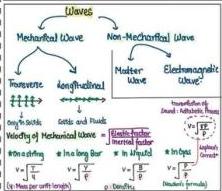
A$v=\sqrt{\dfrac{T}{\mu}}$
B$v=\sqrt{\dfrac{\mu}{T}}$
C$v=\dfrac{T}{\mu}$
D$v=\sqrt{T\mu}$
Answer & Solution
Correct answer: A. $v=\sqrt{\dfrac{T}{\mu}}$
For a stretched string, wave speed is $v=\sqrt{T/\mu}$, where $T$ is the tension and $\mu$ is the linear mass density. Greater tension increases speed, while greater mass per unit length decreases it.
Related questions
Frequency is one of the concepts used to describe motion that is:The letter used for the length of the pendulum string is:The letter used for the mass of the pendulum bob is:Any material medium can be pictured as a collection of:Besides free oscillations, the topic also treats oscillations that are damped and:Because the string is massless, the pendulum's moment of inertia comes from the:The free end of the pendulum string is fixed to a support that is:The string of a simple pendulum is also assumed to be: