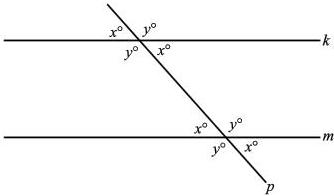
 In the figure above, lines $k$ and $m$ are parallel and are cut by a transversal $p$, forming eight angles. Four of the angles measure $x^{\circ}$ and the remaining four measure $y^{\circ}$. If $x = 110$, what is $y$?
A$55$
B$70$
C$90$
D$110$
Answer & Solution
Correct answer: B. $70$
When a transversal cuts two parallel lines, the eight angles produced are split into two congruence classes — one set of four equal acute angles, and one set of four equal obtuse angles. Any acute angle and any obtuse angle in this configuration are **supplementary** (they together form a straight angle on the line).
So $x + y = 180$. With $x = 110$, we get $y = 180 - 110 = 70$.
- Trap A ($55$) is half of $x$ — would apply only if a line were *bisecting* the angle.
- Trap C ($90$) treats the lines as if they met at a right angle.
- Trap D ($110$) ignores the figure entirely and matches the two groups, which violates the figure (the angles are split into two distinct measures).
Note: without the figure you can't see the eight-angle pattern, so this question is figure-anchored.
Related questions
GMAT DS questions should be paced at:The sum of 5 consecutive integers is always divisible by:If x² = 36, what can we conclude about x?A GMAT PS question asks: 'What is x if 3x + 5 = 23?' Options: 4, 5, 6, 7. The fastest apprOn a percentage question with abstract values, the recommended smart-number to assume is:Is 1,287 divisible by 3?In a GMAT DS question, what is the FIRST step?In GMAT DS, answer choice (A) is selected when: