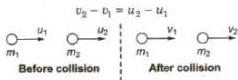
 A body of mass $m_1$ moving with velocity $u_1$ collides head-on with a body of mass $m_2$ at rest. After a perfectly elastic collision, the velocity $v_1$ of the first body is:
A$v_1 = \dfrac{m_1 - m_2}{m_1 + m_2} u_1$
B$v_1 = \dfrac{m_2 - m_1}{m_1 + m_2} u_1$
C$v_1 = u_1$
D$v_1 = -u_1$
Answer & Solution
Correct answer: A. $v_1 = \dfrac{m_1 - m_2}{m_1 + m_2} u_1$
**Perfectly elastic collision** conserves both momentum and kinetic energy. With target at rest ($u_2 = 0$):
$v_1 = \dfrac{m_1 - m_2}{m_1 + m_2} u_1$.
**Sanity checks:**
- If $m_1 = m_2$: $v_1 = 0$, $v_2 = u_1$. The first body stops, the second moves with the original speed. (Classic Newton's cradle behaviour.)
- If $m_2 \gg m_1$ (e.g. ball bouncing off a wall): $v_1 \approx -u_1$, the ball reverses. Option D is right *only* in this limit.
- If $m_1 \gg m_2$: $v_1 \approx u_1$, the heavy body keeps going. Option C is right *only* in this limit.
Related questions
A crate dragged across a rough floor loses mechanical energy because friction is:Conservation of mechanical energy is the form the work-energy theorem takes when the forceCalculating work for a conservative force is easier than for a complicated path because itA force acting entirely perpendicular to an object's displacement does how much work?Mechanical energy transferred into or out of a system equals the work done by an external Winding up a toy or an old-fashioned watch stores energy by doing work against its:Which three energy examples are named together?The kinetic energy in the work-energy theorem is specifically the translational kinetic en