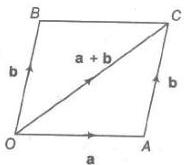
 Two vectors $\vec{a}$ and $\vec{b}$ are drawn from the same starting point as adjacent sides of a parallelogram. According to the parallelogram law of vector addition, the resultant $\vec{a} + \vec{b}$ is:
AThe longer side of the parallelogram
BThe perimeter of the parallelogram
CThe diagonal of the parallelogram drawn from the common starting point
DThe sum of the magnitudes $|\vec{a}| + |\vec{b}|$
Answer & Solution
Correct answer: C. The diagonal of the parallelogram drawn from the common starting point
Parallelogram law: when two vectors emerging from the same point are taken as adjacent sides of a parallelogram, the diagonal drawn from that point represents the resultant in both magnitude and direction.
Option D is only true when $\vec{a}$ and $\vec{b}$ are parallel and pointing the same way. In general, $|\vec{a} + \vec{b}| \leq |\vec{a}| + |\vec{b}|$, with equality only in the parallel case.
Related questions
The result a cross b is a:The area of a triangle from its three vertices can be found using:The area of a parallelogram with sides a and b uses the magnitude of their:For mutually perpendicular unit vectors, i cross j equals:The cross product of two nonzero vectors is zero when they are:The angle between two vectors can be found in terms of their:The vector product is an operation that is:The scalar product is an operation that is: