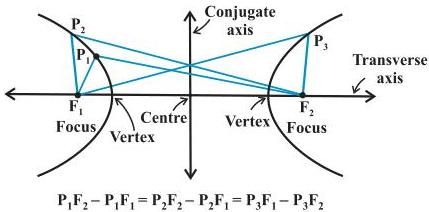
 For any point $P$ on a hyperbola with foci $F_1$ and $F_2$ (transverse-axis length $2a$), the absolute difference $|PF_1 - PF_2|$ equals:
A$2a$
B$2b$
C$2c$
D$a + b$
Answer & Solution
Correct answer: A. $2a$
**Definition of a hyperbola**: the locus of points $P$ such that the *absolute difference* of distances to the two foci is a constant — exactly $2a$, the length of the transverse axis.
$$|PF_1 - PF_2| = 2a$$
(For comparison, the ellipse uses *sum* of distances $= 2a$ — same $2a$, different operator. Both are the load-bearing definitional identity for their conic.)
**Why option C ($2c$) is tempting**: $2c$ is the *distance between the foci*, not the locus's invariant. The points where this difference equals $2c$ lie *on* the focal segment, not on the hyperbola.
Related questions
The latus rectum of an ellipse is perpendicular to the:The latus rectum of a parabola passes through the:A hyperbola is the set of points where the difference of two distances is:The eccentricity of an ellipse is defined as a ratio of two:The two fixed points used to define an ellipse are called the:An ellipse is the set of points where the sum of two distances is:The fixed line used to define a parabola is called the:A parabola is the set of points equidistant from a fixed line and a fixed: