Home › NEET UG › Thermodynamics & Kinetic Theory › An ideal gas expands isothermally from a volume …
An ideal gas expands isothermally from a volume $V_{1}$ to $V_{2}$ and then compressed to original volume $V_{1}$ adiabatically. Initial pressure is $P_{1}$ and final pressure is $P_{3}$. The total work done is $W$. Then 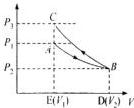
A$P_{3} > P_{1}, W > 0$
B$P_{3} < P_{1}, W < 0$
C$P_{3} > P_{1}, W < 0$
D$P_{3} = P_{1}, W = 0$
Answer & Solution
Correct answer: C. $P_{3} > P_{1}, W < 0$
Initially the gas is at $A(V_1,P_1)$. After isothermal expansion to $B(V_2,P_2)$, we have $$P_1V_1=P_2V_2.$$ Then the gas is compressed adiabatically from $B$ to $C(V_1,P_3)$, so $$P_2V_2^{\gamma}=P_3V_1^{\gamma}.$$ Using $P_2=P_1V_1/V_2$ from the isothermal step, $$P_3=P_1\left(\frac{V_2}{V_1}\right)^{\gamma-1}.$$ Since $V_2>V_1$ and $\gamma>1$, it follows that $$P_3>P_1.$$ Now compare works. In the expansion from $V_1$ to $V_2$, the work by the gas is the area under the isothermal curve. In the return adiabatic compression from $V_2$ to $V_1$, the adiabatic curve lies above the isothermal curve between the same volumes, so the magnitude of compression work is larger than the expansion work. Therefore the net work done by the gas over the two processes is negative, hence $$W<0.$$ Re-reading the options, the one matching $$P_3>P_1$$ and $$W<0$$ is option $C$.
Related questions
The combination of heat minus work is described as:Which law forbids a book on a table hopping up by itself?In an isochoric process the heat absorbed goes entirely to change:In an isochoric process, the work done is:In an adiabatic process, work done by the gas decreases its:In an adiabatic process, the heat absorbed or released is:A process at constant volume is called:A process at constant pressure is called: