Two masses $m_1$ and $m_2$ are suspended together by a massless spring of constant $K$. When the masses are in equilibrium, $m_1$ is removed without disturbing the system. The amplitude of oscillations is 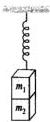
A$\frac{m_1g}{K}$
B$\frac{m_2g}{K}$
C$\frac{(m_1 + m_2)}{K}$
D$\frac{(m_1 - m_2)}{K}$
Answer & Solution
Correct answer: A. $\frac{m_1g}{K}$
Initially, the spring supports both masses, so the equilibrium extension is $$x_1=\frac{(m_1+m_2)g}{K}.$$ After removing $m_1$, the new equilibrium extension for the remaining mass is $$x_2=\frac{m_2g}{K}.$$ At the instant $m_1$ is removed, $m_2$ is still at the old equilibrium position and has zero velocity, so its displacement from the new equilibrium position is $$A=x_1-x_2.$$ Therefore, $$A=\frac{(m_1+m_2)g}{K}-\frac{m_2g}{K}=\frac{m_1g}{K}.$$ This matches option $A$.
Related questions
Frequency is one of the concepts used to describe motion that is:The letter used for the length of the pendulum string is:The letter used for the mass of the pendulum bob is:Any material medium can be pictured as a collection of:Besides free oscillations, the topic also treats oscillations that are damped and:Because the string is massless, the pendulum's moment of inertia comes from the:The free end of the pendulum string is fixed to a support that is:The string of a simple pendulum is also assumed to be: