A man weighing $60\,\mathrm{kg}$ stands on the horizontal platform of a spring balance. The platform starts executing simple harmonic motion of amplitude $0.1\,\mathrm{m}$ and frequency $\frac{2}{\pi}\,\mathrm{Hz}$. Which of the following statement is correct 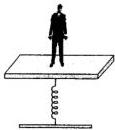
AThe spring balance reads the weight of man as $60\,\mathrm{kg}$
BThe spring balance reading fluctuates between $60\,\mathrm{kg}$ and $70\,\mathrm{kg}$
CThe spring balance reading fluctuates between $50\,\mathrm{kg}$ and $60\,\mathrm{kg}$
DThe spring balance reading fluctuates between $50\,\mathrm{kg}$ and $70\,\mathrm{kg}$
Answer & Solution
Correct answer: D. The spring balance reading fluctuates between $50\,\mathrm{kg}$ and $70\,\mathrm{kg}$
For vertical $\mathrm{SHM}$, the apparent weight is the normal reaction $N$.
$$N = m(g+a)$$
In $\mathrm{SHM}$, maximum acceleration is
$$a_{\max} = \omega^2 A$$
The angular frequency is
$$\omega = 2\pi f = 2\pi \times \frac{2}{\pi} = 4\,\mathrm{rad\,s^{-1}}$$
So,
$$a_{\max} = 4^2 \times 0.1 = 1.6\,\mathrm{m\,s^{-2}}$$
Hence the reaction fluctuates between
$$N_{\min} = m(g-a_{\max})$$
and
$$N_{\max} = m(g+a_{\max})$$
For $m=60\,\mathrm{kg}$,
$$N_{\min} = 60(9.8-1.6) = 492\,\mathrm{N}$$
$$N_{\max} = 60(9.8+1.6) = 684\,\mathrm{N}$$
A spring balance calibrated in $\mathrm{kg}$ shows $\frac{N}{g}$. Therefore the reading varies between
$$\frac{492}{9.8} \approx 50.2\,\mathrm{kg}$$
and
$$\frac{684}{9.8} \approx 69.8\,\mathrm{kg}$$
So the reading fluctuates between $50\,\mathrm{kg}$ and $70\,\mathrm{kg}$. After checking the options, this matches option $D$.
Related questions
Frequency is one of the concepts used to describe motion that is:The letter used for the length of the pendulum string is:The letter used for the mass of the pendulum bob is:Any material medium can be pictured as a collection of:Besides free oscillations, the topic also treats oscillations that are damped and:Because the string is massless, the pendulum's moment of inertia comes from the:The free end of the pendulum string is fixed to a support that is:The string of a simple pendulum is also assumed to be: