JEE Main Aldehydes, Ketones and Carboxylic Acids — practice questions
103 free MCQs with worked solutions. Tap any question for the answer + explanation, or practice them all in the app.
Practice JEE Main Aldehydes, Ketones and Carboxylic Acids in the app →The functional group $>\!\mathrm{C}\!=\!\mathrm{O}$ that is common to aldehydes, ketones, carboxylic acids andReduction of an aldehyde with $\mathrm{NaBH_4}$ or $\mathrm{LiAlH_4}$ produces:Which reagent distinguishes aldehydes from ketones by giving a positive (silver mirror) reaction only with aldThe aldol condensation requires which structural feature on the carbonyl compound?Benzaldehyde is treated with concentrated $\mathrm{NaOH}$ (Cannizzaro reaction). The products are:Arrange in **decreasing** order of acidic strength: $\mathrm{CH_3COOH}$, $\mathrm{FCH_2COOH}$, $\mathrm{CF_3COHydrocarbons are organic compounds composed exclusively of: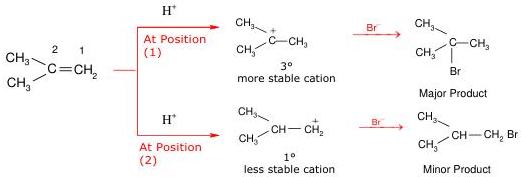
When propene reacts with HBr, Markovnikov's rule In the presence of organic peroxides, addition of HBr to propene gives predominantly:Wurtz reaction is used to prepare:According to Hückel's rule, a planar cyclic compound is aromatic if it has: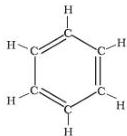
Benzene is best described by:Functional group of aldehyde:Functional group of ketone:Functional group of carboxylic acid:Carbonyl carbon hybridization:IUPAC name of CH₃CHO:Fehling's test positive for:Nucleophilic addition to carbonyl: nucleophile attacks:Reduction of aldehyde RCHO by NaBH₄ gives:For α,β-unsaturated ketones (enones), 1,4-addition (Michael) competes with 1,2-addition. Soft nucleophiles preClemmensen reduction converts C=O to CH₂ using:Esterification: RCOOH + R'OH + acid catalyst yields:In Friedel-Crafts acylation, RCOCl + AlCl₃ + benzene gives:Glycine has 2 amino acid forms in solution. Zwitterion:Per NCERT §9.2, the general formula of an alkane (saturated open-chain hydrocarbon) is which?Per NCERT §9.2 + Fig 9.1, the H-C-H bond angle in methane and the carbon hybridisation are which?Per NCERT §9.2.2(2)(ii), the Wurtz reaction uses which reagent + solvent for coupling alkyl halides?Per NCERT §9.2.2(3)(i), heating CH₃COONa with NaOH + CaO (soda-lime) produces which gas?Per NCERT §9.2.2(3)(ii), in Kolbe electrolytic synthesis of alkanes, the alkane gas is liberated at which elecPer NCERT §9.2.3, the rate of HALOGENATION of alkanes (F₂, Cl₂, Br₂, I₂) decreases in which order?Per NCERT §9.2.3, the rate of substitution of HYDROGENS in alkane halogenation goes in which order (by carbon Per NCERT §9.2.3 Mechanism, the FIRST step of methane chlorination under sunlight is best described as which?Per NCERT §9.2.4, the STAGGERED conformation of ethane is more stable than the eclipsed conformation by approxPer NCERT §9.2.4, the STAGGERED form of ethane is more stable than ECLIPSED for which reason?Per NCERT §9.2.3 + Table 9.2, isomeric pentanes (n-pentane, 2-methylbutane, neopentane) have which boiling-poiPer NCERT §9.2.2(1), hydrogenation of an alkene to an alkane uses dihydrogen with which kind of catalyst?Per NCERT §9.3.1, in ethene the C-C bond consists of which σ/π combination, and the carbons are which hybridisPer NCERT §9.3.3, geometrical (cis-trans) isomerism in alkenes arises because of which feature of the double bPer NCERT §9.3.3, the dipole moment of cis-but-2-ene (0.33 D) and trans-but-2-ene (≈ 0 D) shows which form is Per NCERT §9.3.4(1), partial reduction of an alkyne to a CIS alkene uses which catalyst?Per NCERT §9.3.4(1), reduction of an internal alkyne with Na in LIQUID NH₃ gives which kind of alkene?Per NCERT §9.3.6 (Markovnikov rule, 1869), HBr addition to propene gives mainly which product?Per NCERT §9.3.6, the peroxide (Kharasch) effect on HBr addition to propene gives mainly which product?Per NCERT §9.3.6, the peroxide effect is observed only with which hydrogen halide?Per NCERT §9.3.6 (electrophilic addition mechanism), the rate-determining intermediate in HBr + propene additiPer NCERT §9.3.6, mild oxidation of an alkene with cold dilute KMnO₄ (Baeyer's reagent) gives which product?Per NCERT §9.3.6 (ozonolysis), reductive ozonolysis of an alkene with O₃ followed by Zn/H₂O gives which class Per NCERT §9.3.6, addition of conc. H₂SO₄ to an alkene followed by water gives mainly which class of compound?Per NCERT §9.4 (structure), the carbon-carbon triple bond in ethyne (HC≡CH) consists of which σ/π combination?Per NCERT §9.4.1, the C-H bond in ethyne is unusually ACIDIC because of which factor?Per NCERT §9.4.2, calcium carbide (CaC₂) reacts with water to give which gas?Per NCERT §9.4.2, dehalogenation of vicinal dihalide with alcoholic KOH gives which class of compound?Per NCERT §9.4.3 (acidic character), terminal alkynes react with sodium metal to liberate which gas + sodium aPer NCERT §9.4.3, addition of water to ethyne in dilute H₂SO₄ with HgSO₄ catalyst gives which final product?Per NCERT §9.4.3, addition of water to propyne under HgSO₄/H₂SO₄ gives mainly which product (Markovnikov)?Per NCERT §9.4.4 (cyclic polymerisation), three molecules of ethyne polymerise over a hot red-hot tube to givePer NCERT §9.4.3 (addition of HBr), HBr addition to propyne gives which Markovnikov product?Per NCERT §9.3.4(1), reduction of an alkyne to a TRANS alkene uses which reagent system?Per NCERT §9.4 (general formula), the general molecular formula of an open-chain alkyne is which?Per NCERT §9.4 (structure), the C-H bond in ethyne has shorter bond length than that in ethane because of whicPer NCERT §9.5.3, the THREE criteria for aromaticity (Hückel) are which set?Per NCERT §9.5.3, for benzene the value of n in Hückel's (4n+2) π electron formula is which?Per NCERT §9.5.2, all six C-C bond lengths in benzene are equal to approximately which value?Per NCERT §9.5.2, the carbon atoms of benzene are which hybridisation?Per NCERT §9.5.5, the FIVE common electrophilic substitution reactions of benzene are which set?Per NCERT §9.5.5 nitration, the actual ELECTROPHILE that attacks benzene in HNO₃ + H₂SO₄ mixture is which specPer NCERT §9.5.5 halogenation, the role of anhydrous AlCl₃ (or FeCl₃) in benzene chlorination is which?Per NCERT §9.5.5(iv), Friedel-Crafts ALKYLATION of benzene uses which reagent system?Per NCERT §9.5.5(v), Friedel-Crafts ACYLATION of benzene uses an acyl halide + AlCl₃ to generate which electroPer NCERT §9.5.5 (EAS mechanism), the carbocation intermediate formed during EAS on benzene is called which spPer NCERT §9.5.6, which of the following groups is a META-directing substituent on benzene?Per NCERT §9.5.6, halogens (-Cl, -Br) on benzene are which kind of directors despite their deactivating -I effThe general formula for alkanes is:Adding HBr to propene CH$_3$-CH=CH$_2$ in absence of peroxide gives mainly:Benzene satisfies Hückel's rule with $4n + 2$ pi electrons for $n =$:Nitration of toluene (methylbenzene) on the lab gives products mostly at:Aldehydes are generally more reactive than ketones in nucleophilic addition because:Tollens' reagent gives a silver mirror with:Carboxylic acids are more acidic than alcohols because:Among acetic acid, chloroacetic acid, dichloroacetic acid, trichloroacetic acid, the strongest acid is:The carbon to oxygen double bond is called the:In an aldehyde the carbonyl carbon is bonded to carbon and:In a ketone the carbonyl group is bonded to:A carbonyl carbon carrying a hydroxyl group gives a:A carbonyl carbon attached to a halogen gives an:Esters and anhydrides are derivatives of:Vanillin, with its pleasant fragrance, comes from:Cinnamaldehyde is obtained from:Salicylaldehyde is obtained from:Acetone is manufactured mainly for use as a:The carbonyl carbon and its three attached atoms lie:The bond angles around a carbonyl carbon are about:The shape around the carbonyl group is described as:The carbon to oxygen double bond is polarised because oxygen is more:The carbonyl carbon behaves as a centre that is:At room temperature methanal exists as a:Aldehydes boil higher than hydrocarbons of like mass because of:Aldehydes boil lower than alcohols of like mass because they lack:Methanal, ethanal and propanone mix with water in:Solubility of aldehydes falls as the alkyl chain grows:Aldehydes and ketones take part in addition that is:Against ketones, aldehydes in nucleophilic addition are: