Home › UP Board Class 10 › Mathematics › In Fig. 6.31, given $OA\cdot OB = OC\cdot OD$, w…
In Fig. 6.31, given $OA\cdot OB = OC\cdot OD$, which conclusion follows from the similarity of the relevant triangles? 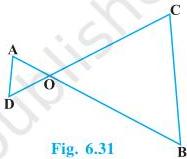
A$\angle A = \angle C$ and $\angle B = \angle D$
B$\angle A = \angle B$ and $\angle C = \angle D$
C$OA = OC$ and $OB = OD$
D$AB \parallel CD$
Answer & Solution
Correct answer: A. $\angle A = \angle C$ and $\angle B = \angle D$
Using $\frac{OA}{OC}=\frac{OD}{OB}$ and the vertically opposite angles $\angle AOD=\angle COB$, we get $\triangle AOD \sim \triangle COB$ by SAS. Hence corresponding angles are equal, so $\angle A=\angle C$ and $\angle D=\angle B$, i.e. $\angle B=\angle D$.
Related questions
When variables and numbers appear on both sides, you must simplify:Equations needing more than one operation are described as taking more:Once a solution is found, it should be checked by substituting it back to get a statement The product of any number and its reciprocal equals:A fraction multiplying the variable is best removed by multiplying by its:Solving x divided by 4 equals 3 gives x equal to:Solving 4x equals 20 gives x equal to:Solving x minus 8 equals 5 gives x equal to: