Two mirrors meet at right angles (i.e. inclined at 90°). A ray of light strikes the first mirror at 30° as shown. 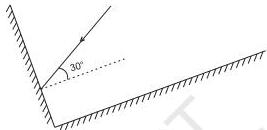 After being reflected off both mirrors, the final reflected ray emerges:
AAt an angle of 60° to the incident ray
BPerpendicular to the incident ray
CParallel to the incident ray (but oppositely directed)
DAlong the same line as the incident ray (back on itself)
Answer & Solution
Correct answer: C. Parallel to the incident ray (but oppositely directed)
Two mirrors at 90° behave like a corner reflector. A ray reflected off each mirror once emerges parallel to the original direction but reversed — i.e. anti-parallel. Quick reasoning: At mirror 1 (∠i = 30°), the ray bends by 2 × 30° = 60° from its original direction. At mirror 2, by symmetry, it bends by another 2 × 60° = 120°. Total turn = 180°, so the emerging ray runs back parallel to the incoming ray. This is why corner reflectors (three mirrors at right angles) are used as reliable retro-reflectors on cars, road signs, and the lunar laser ranging experiment.
Related questions
Which property of a concave mirror makes it suitable for a dentist?A ray travelling parallel to the principal axis of a concave mirror is reflected:Where must an object sit for a concave mirror to form a virtual, magnified, erect image?What quantity is measured in lux and describes how many lumens fall on each square metre oFor yellow light with a wavelength of 6.00 x 10^-7 m, what frequency does c equals f timesOne light year is the distance light travels in one year. What is that distance in kilometA photographer measures 39.8 lux from a 2,000 lumen bulb held 2.00 m away, using illuminanPolarized sunglasses cut down glare from a lake. How do the lenses achieve this?