Even surfaces that look perfectly smooth — like glass or polished steel — have a large number of microscopic bumps and pits. 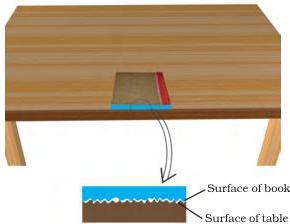 What does this fact imply about friction?
AFriction has nothing to do with the smoothness of surfaces
BFriction can be reduced, but never entirely eliminated, since no real surface is perfectly smooth
CFriction is greater on smooth surfaces than rough ones
DFriction can be made exactly zero by polishing surfaces enough
Answer & Solution
Correct answer: B. Friction can be reduced, but never entirely eliminated, since no real surface is perfectly smooth
Polishing reduces the size and number of irregularities but cannot make them disappear at the microscopic level. Lubricants help further by separating the surfaces. But some friction always remains — the chapter states friction can never be entirely eliminated.
Related questions
Two masses hang from a rope over a light frictionless pulley. Along that rope the tension Spreading out into a spread-eagle position drops that terminal speed to about:A 75 kg skydiver falling head first reaches a terminal speed of roughly:Drag also depends on the density of the fluid, the drag coefficient and the object's:At everyday speeds, drag force is proportional to the speed of the object raised to the poLike friction, the drag force on a moving object always acts to oppose its:The outward pull a rider seems to feel on a merry-go-round is mistakenly called the:A passenger feels thrown sideways when the car turns. That apparent push is an inertial or