Home › JEE Advanced › Vectors & 3D Geometry › If a point has coordinates $(x,y)$, then its pos…
If a point has coordinates $(x,y)$, then its position vector from the origin is 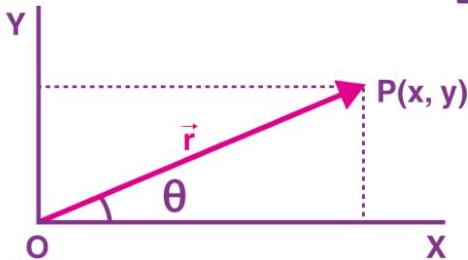
A$\vec r = x\hat{i} - y\hat{j}$
B$\vec r = y\hat{i} + x\hat{j}$
C$\vec r = x\hat{i} + y\hat{j}$
D$\vec r = \sqrt{x^2+y^2}\,(\hat{i}+\hat{j})$
Answer & Solution
Correct answer: C. $\vec r = x\hat{i} + y\hat{j}$
For a point $P(x,y)$, the notes give the position vector as $\vec r = x\hat{i} + y\hat{j}$. Its magnitude is $|\vec r| = \sqrt{x^2+y^2}$, not the vector form in option D.
Related questions
Two nonzero vectors have a scalar product of zero when they are:The vector product of two vectors gives a:The dot product of two vectors returns a:Vectors that may be shifted parallel without change are called:The triangle law and the parallelogram law of addition are:Two vectors on adjacent sides of a parallelogram add along the:The relation AC = AB + BC states the:A vector equal in size but opposite in direction is the: