According to the parallelogram law shown, the diagonal through the common initial point represents 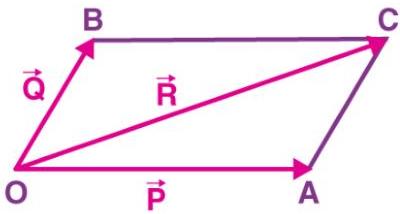
Athe difference $\vec P-\vec Q$
Bthe product $\vec P\cdot\vec Q$
Cthe resultant $\vec P+\vec Q$
Da unit vector along $\vec P$
Answer & Solution
Correct answer: C. the resultant $\vec P+\vec Q$
The parallelogram law states that if two vectors act along adjacent sides of a parallelogram from the same point, the diagonal through that point gives their resultant. In the figure, that diagonal is the vector sum $\vec P + \vec Q = \vec R$.
Related questions
Two nonzero vectors have a scalar product of zero when they are:The vector product of two vectors gives a:The dot product of two vectors returns a:Vectors that may be shifted parallel without change are called:The triangle law and the parallelogram law of addition are:Two vectors on adjacent sides of a parallelogram add along the:The relation AC = AB + BC states the:A vector equal in size but opposite in direction is the: