An ideal gas in a cylinder is compressed in a **single step** from volume Vᵢ to volume Vf (Vf < Vᵢ) by a constant external pressure pₑₓ. The shaded area in the figure represents the work done on the gas. Which expression correctly gives this work? 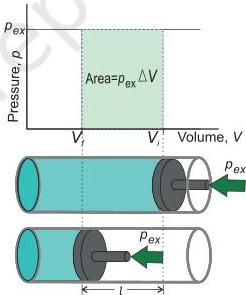
A$w = -p_{ex}(V_f - V_i)$
B$w = -p_{ex}(V_i - V_f)$
C$w = -nRT \ln(V_f / V_i)$
D$w = 0$
Answer & Solution
Correct answer: A. $w = -p_{ex}(V_f - V_i)$
Force × distance gives $w = p_{ex} \cdot A \cdot l$, and the sign convention (work done on the gas is positive) requires $w = -p_{ex}\Delta V = -p_{ex}(V_f - V_i)$. Since Vf < Vᵢ here, (Vf − Vᵢ) is negative and the work comes out positive — consistent with the system gaining energy during compression. (B) flips the sign (gives negative work for compression — wrong). (C) is the **reversible** isothermal expression, not single-step. (D) holds only for free expansion into vacuum (pₑₓ = 0).
Related questions
A machinist calculates a temperature rise in a copper fitting and needs a property of coppThree different quasi-static routes connect the same two equilibrium states. Work generallA system is taken through several steps and ends in exactly the state it began in. That seThe gas is then cooled in a rigid container so its volume cannot change. That process is:A gas expands while the pressure is held constant. That process is described as:A gas is insulated so that no heat enters or leaves while its state changes. That process In an ideal gas that process leaves internal energy unchanged, so all the heat supplied goA gas expands while its temperature is held constant throughout. That process is: