Light travels from air $(n_1=1)$ into glass $(n_2=1.5)$ through a spherical surface of radius of curvature $R=+20\,\text{cm}$. If the object is at $u=-100\,\text{cm}$, the image distance $v$ is 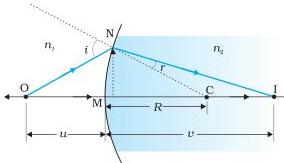
A$+100\,\text{cm}$
B$-100\,\text{cm}$
C$+40\,\text{cm}$
D$-40\,\text{cm}$
Answer & Solution
Correct answer: A. $+100\,\text{cm}$
Use the refraction-at-a-spherical-surface formula $\dfrac{n_2}{v}-\dfrac{n_1}{u}=\dfrac{n_2-n_1}{R}$. Substituting $n_1=1$, $n_2=1.5$, $u=-100\,\text{cm}$, and $R=+20\,\text{cm}$ gives $\dfrac{1.5}{v}+\dfrac{1}{100}=\dfrac{0.5}{20}=\dfrac{1}{40}$. Hence $\dfrac{1.5}{v}=\dfrac{1}{40}-\dfrac{1}{100}=\dfrac{3}{200}$, so $v=+100\,\text{cm}$. The positive sign means the image forms in the second medium, in the direction of incident light.
Related questions
Which colour travels fastest in a glass prism?Dispersion happens because the refractive index differs with:Violet light has a wavelength of about:In the visible spectrum, red light lies at the:A lens of power minus 4.0 D is a concave lens of focal length:A prescribed lens of power plus 2.5 D is a convex lens of focal length:The power of a converging lens is:A lens of focal length one metre has a power of: