For a thin lens, the image formed by the first refracting surface acts as a virtual object for the second surface. Which additional approximation is used to combine the two spherical-surface refraction equations into the thin lens relation? 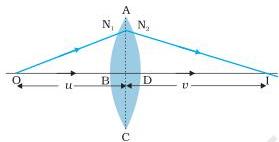 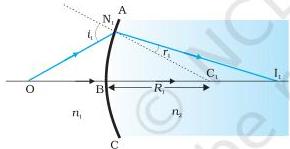 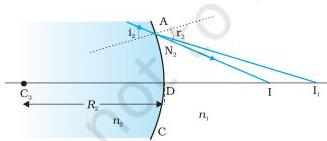
AThe lens material has refractive index equal to that of the surrounding medium
BThe lens aperture is taken to be infinite
CThe lens is thin enough that $BI_1 = DI_1$
DThe object is always placed at infinity
Answer & Solution
Correct answer: C. The lens is thin enough that $BI_1 = DI_1$
In the thin lens approximation, the two refracting surfaces are very close to each other, so the intermediate image distance measured from the first surface is effectively the same as that measured from the second surface: $BI_1 = DI_1$. This allows the two interface equations to be added directly and leads to the thin lens relations. The object need not be at infinity except for defining the focal length.
Related questions
Which colour travels fastest in a glass prism?Dispersion happens because the refractive index differs with:Violet light has a wavelength of about:In the visible spectrum, red light lies at the:A lens of power minus 4.0 D is a concave lens of focal length:A prescribed lens of power plus 2.5 D is a convex lens of focal length:The power of a converging lens is:A lens of focal length one metre has a power of: