Two thin lenses of focal lengths $f_1$ and $f_2$ are in contact. What is the correct expression for the effective focal length $f$ of the combination? 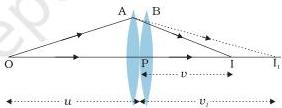
A$f=f_1+f_2$
B$\dfrac{1}{f}=\dfrac{1}{f_1}+\dfrac{1}{f_2}$
C$\dfrac{1}{f}=\dfrac{1}{f_1}-\dfrac{1}{f_2}$
D$f=\dfrac{f_1-f_2}{2}$
Answer & Solution
Correct answer: B. $\dfrac{1}{f}=\dfrac{1}{f_1}+\dfrac{1}{f_2}$
For thin lenses in contact, the lens formula applied successively gives $$\frac{1}{v}-\frac{1}{u}=\frac{1}{f_1}+\frac{1}{f_2}.$$ If the pair is replaced by a single equivalent lens, then $$\frac{1}{v}-\frac{1}{u}=\frac{1}{f},$$ so $$\frac{1}{f}=\frac{1}{f_1}+\frac{1}{f_2}.$$ This is why powers add directly for lenses in contact.
Related questions
Which colour travels fastest in a glass prism?Dispersion happens because the refractive index differs with:Violet light has a wavelength of about:In the visible spectrum, red light lies at the:A lens of power minus 4.0 D is a concave lens of focal length:A prescribed lens of power plus 2.5 D is a convex lens of focal length:The power of a converging lens is:A lens of focal length one metre has a power of: