A compound microscope has objective focal length $f_o=1.0\,\mathrm{cm}$, eyepiece focal length $f_e=2.0\,\mathrm{cm}$, and tube length $L=20\,\mathrm{cm}$. If the final image is formed at infinity, what is its magnification? 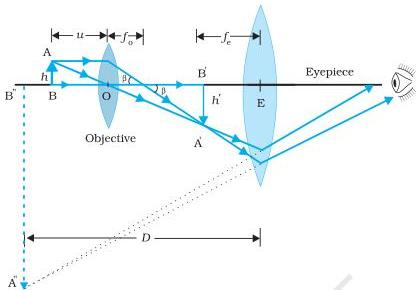
A10
B50
C100
D250
Answer & Solution
Correct answer: D. 250
For a compound microscope with final image at infinity, the total magnification is $$m=\left(\frac{L}{f_o}\right)\left(\frac{D}{f_e}\right),$$ where $D=25\,\mathrm{cm}$. Substituting, $$m=\frac{20}{1}\times\frac{25}{2}=20\times 12.5=250.$$ So the microscope magnifies the object 250 times.
Option C might seem tempting if one uses only $f_o/f_e$, but that formula is for a telescope, not a compound microscope.
Related questions
Which colour travels fastest in a glass prism?Dispersion happens because the refractive index differs with:Violet light has a wavelength of about:In the visible spectrum, red light lies at the:A lens of power minus 4.0 D is a concave lens of focal length:A prescribed lens of power plus 2.5 D is a convex lens of focal length:The power of a converging lens is:A lens of focal length one metre has a power of: