In Fig. 9.27, the ray in air makes an angle of $60^\circ$ with the normal. The corresponding refracted angles shown are $35^\circ$ in glass [Fig. 9.27(a)] and $47^\circ$ in water [Fig. 9.27(b)]. Using these data, what is the angle of refraction in glass when the angle of incidence in water is $45^\circ$ for the water-glass interface shown in Fig. 9.27(c)? 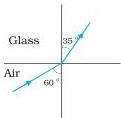 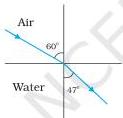 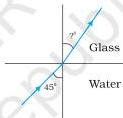
AAbout $32^\circ$
BAbout $39^\circ$
CAbout $47^\circ$
DAbout $60^\circ$
Answer & Solution
Correct answer: A. About $32^\circ$
From Fig. 9.27(a), for air to glass: $n_g=\sin60^\circ/\sin35^\circ$. From Fig. 9.27(b), for air to water: $n_w=\sin60^\circ/\sin47^\circ$. Hence for water to glass, $\dfrac{n_g}{n_w}=\dfrac{\sin47^\circ}{\sin35^\circ}$. Using Snell's law at the water-glass interface, $n_w\sin45^\circ=n_g\sin r$, so $\sin r=(n_w/n_g)\sin45^\circ=(\sin35^\circ/\sin47^\circ)\sin45^\circ\approx 0.53$. Therefore $r\approx 32^\circ$.
Related questions
Which colour travels fastest in a glass prism?Dispersion happens because the refractive index differs with:Violet light has a wavelength of about:In the visible spectrum, red light lies at the:A lens of power minus 4.0 D is a concave lens of focal length:A prescribed lens of power plus 2.5 D is a convex lens of focal length:The power of a converging lens is:A lens of focal length one metre has a power of: