According to the concept map of reflection of light, which combination of sign conventions is correct for a convex mirror? 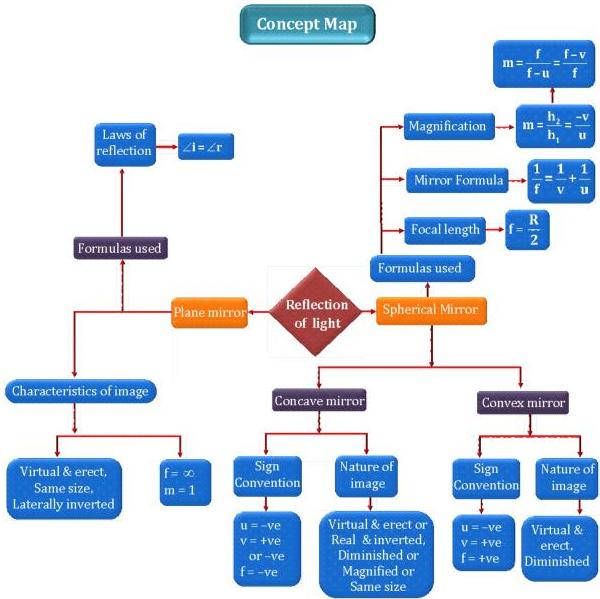
A$u=-\text{ve},\ v=+\text{ve},\ f=+\text{ve}$
B$u=+\text{ve},\ v=-\text{ve},\ f=-\text{ve}$
C$u=-\text{ve},\ v=-\text{ve},\ f=-\text{ve}$
D$u=+\text{ve},\ v=+\text{ve},\ f=-\text{ve}$
Answer & Solution
Correct answer: A. $u=-\text{ve},\ v=+\text{ve},\ f=+\text{ve}$
For a real object in front of any mirror, $u$ is negative. In a convex mirror, the image is virtual and forms behind the mirror, so $v$ is positive, and its focal length is also positive. This matches option A.
Related questions
In a compound microscope, the lens placed near the object has which property compared withFor correcting myopia, a concave lens is used. According to the convention for lens power,The ability of the eye lens to focus on both nearby and distant objects by changing its foFor a hypermetropic person, the near point has shifted to 1.5 m. Using $f = \dfrac{dD}{d-DA myopic person can clearly see objects only up to 4 m and wants to see objects up to 20 mThe eye defect presbyopia, in which a person loses the power of accommodation for both neaIn a myopic (short-sighted) eye, where is the image of a distant object formed relative toTwo thin lenses of powers $+5\ \text{D}$ and $-2\ \text{D}$ are placed in contact. What is